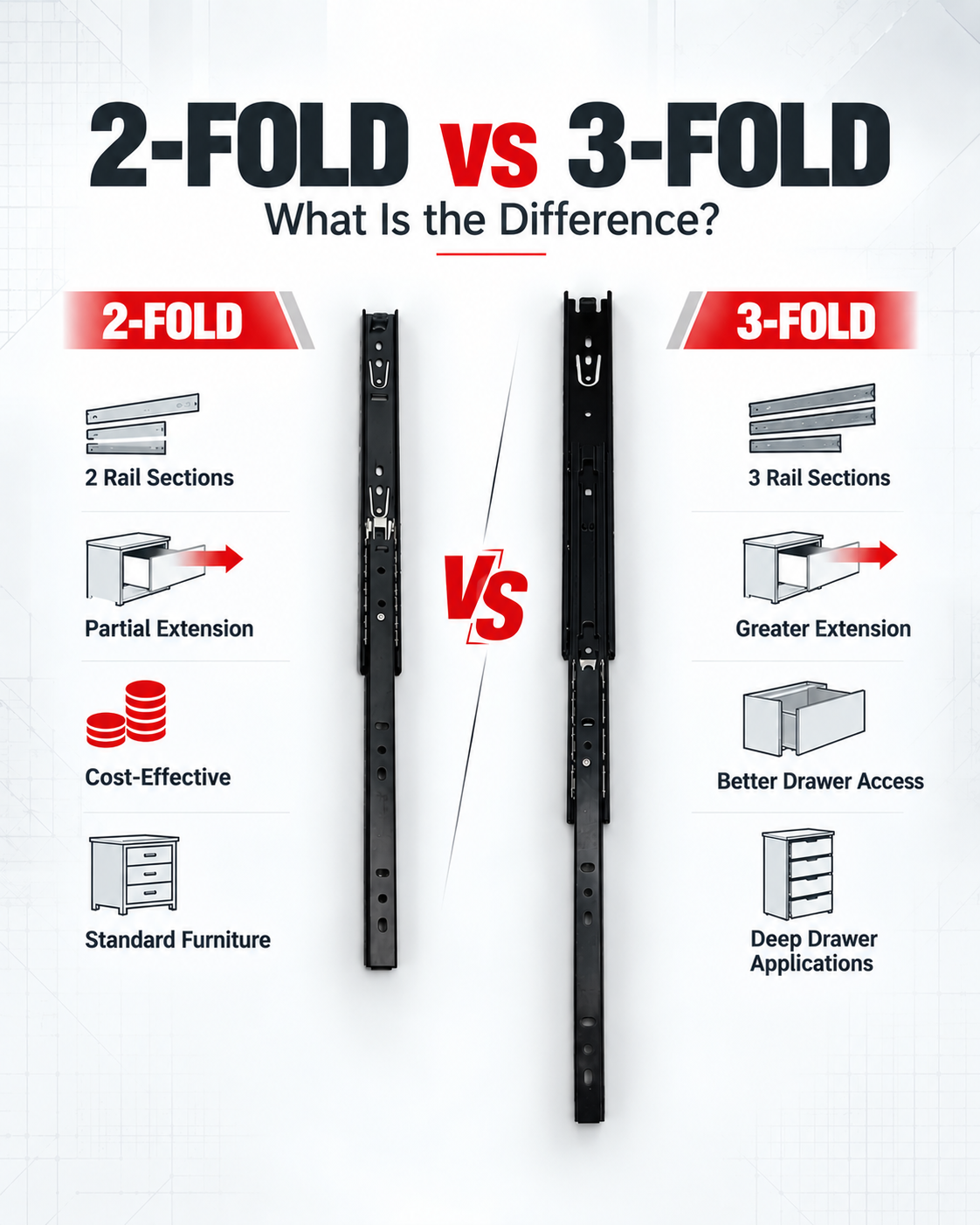
When choosing drawer slides for furniture production, one of the most common questions is: What is the difference between 2-fold and 3-fold drawer slides?
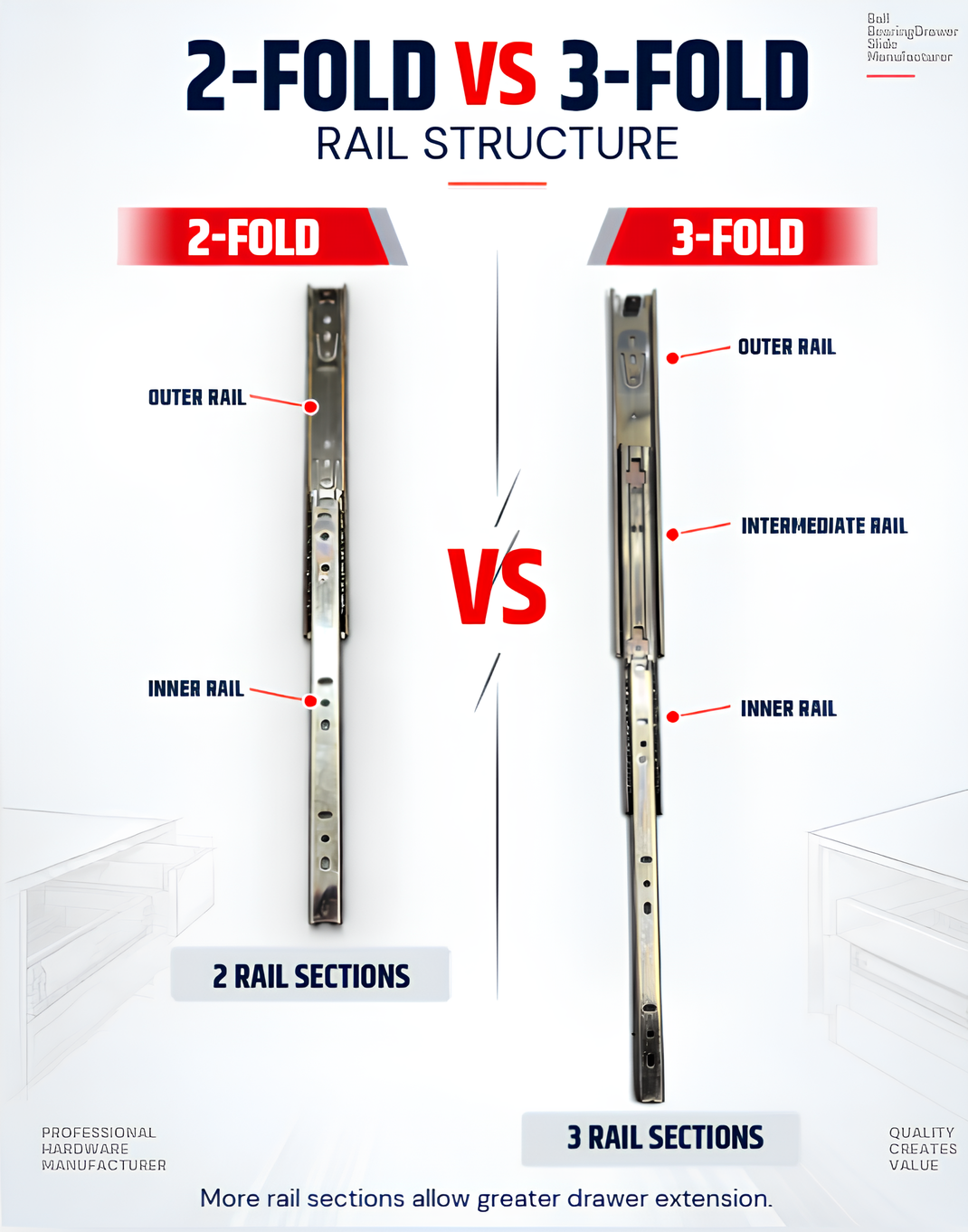
The main difference is the number of rail sections and the amount of drawer extension they provide. A 2-fold drawer slide uses two main rail sections and typically provides partial extension, while a 3-fold drawer slide uses three rail sections and can provide greater extension, allowing more of the drawer to move outside the cabinet.
For furniture manufacturers, importers, and wholesalers, the right choice depends on the drawer design, required access, installation space, load requirements, and target cost.
YUNFA is a professional drawer slide manufacturer in China, supplying 2-fold and 3-fold ball bearing drawer slides for furniture manufacturers, importers, and wholesalers.
A 2-fold drawer slide is suitable when partial drawer extension is sufficient and cost efficiency is important. A 3-fold drawer slide is a better choice when greater extension and access to the inside of the drawer are required.
Neither type is universally better. The correct choice depends on the application.
Feature | 2-Fold Drawer Slide | 3-Fold Drawer Slide |
Rail sections | 2 | 3 |
Extension | Partial | Greater / full extension depending on model |
Drawer access | Standard | Better access |
Structure | Simpler | More sections and components |
Typical application | Standard furniture | Furniture requiring greater extension |
Cost | Generally more economical | Generally higher |
Best for | Cost-sensitive applications | Access-focused applications |
A 2-fold drawer slide consists of two main rail sections that move relative to each other through a ball bearing mechanism.
Because of its simpler structure, a 2-fold slide can be a practical solution for applications where the drawer does not need to extend completely from the cabinet.
Typical applications include:
l Standard furniture drawers
l Basic storage cabinets
l Office furniture
l Bedroom furniture
l Cost-sensitive furniture projects
l High-volume furniture production
For manufacturers producing large quantities of standard furniture, a 2-fold slide can provide a good balance between functionality and cost.
1. Cost efficiency
The simpler rail structure can make 2-fold slides a cost-effective choice for standard furniture applications.
2. Straightforward construction
With fewer rail sections, the overall structure is relatively simple.
3. Suitable for standard drawers
When complete drawer access is not necessary, a 2-fold slide can provide the required functionality without adding unnecessary features.
4. Suitable for high-volume production
For furniture manufacturers producing large quantities of standard drawers, controlling component cost is often important.
A 3-fold drawer slide consists of three rail sections that work together to provide greater extension.
The additional rail section allows the drawer to travel farther outside the cabinet compared with a typical 2-fold configuration.
This can provide better access to the contents of the drawer.
3-fold drawer slides are commonly used in:
l Kitchen cabinets
l Bedroom furniture
l Office furniture
l Storage cabinets
l Tool cabinets
l Commercial furniture
l Drawers requiring greater extension
YUNFA offers several 3-fold drawer slide configurations, including 35mm, 40mm and 45mm series.
The number of rail sections directly affects how the drawer moves.
With a 2-fold slide, the movement is based on two main rail sections. The drawer therefore has a more limited extension.
With a 3-fold slide, three rail sections work together. The additional section allows the drawer to travel farther while maintaining support between the cabinet and drawer.
This is especially useful when users need to reach items located toward the back of a deep drawer.
Imagine a deep kitchen drawer.
With a limited-extension slide, part of the drawer remains inside the cabinet when fully opened. Items at the back may be difficult to reach.
With a suitable 3-fold slide, the drawer can extend farther, providing better visibility and access.


