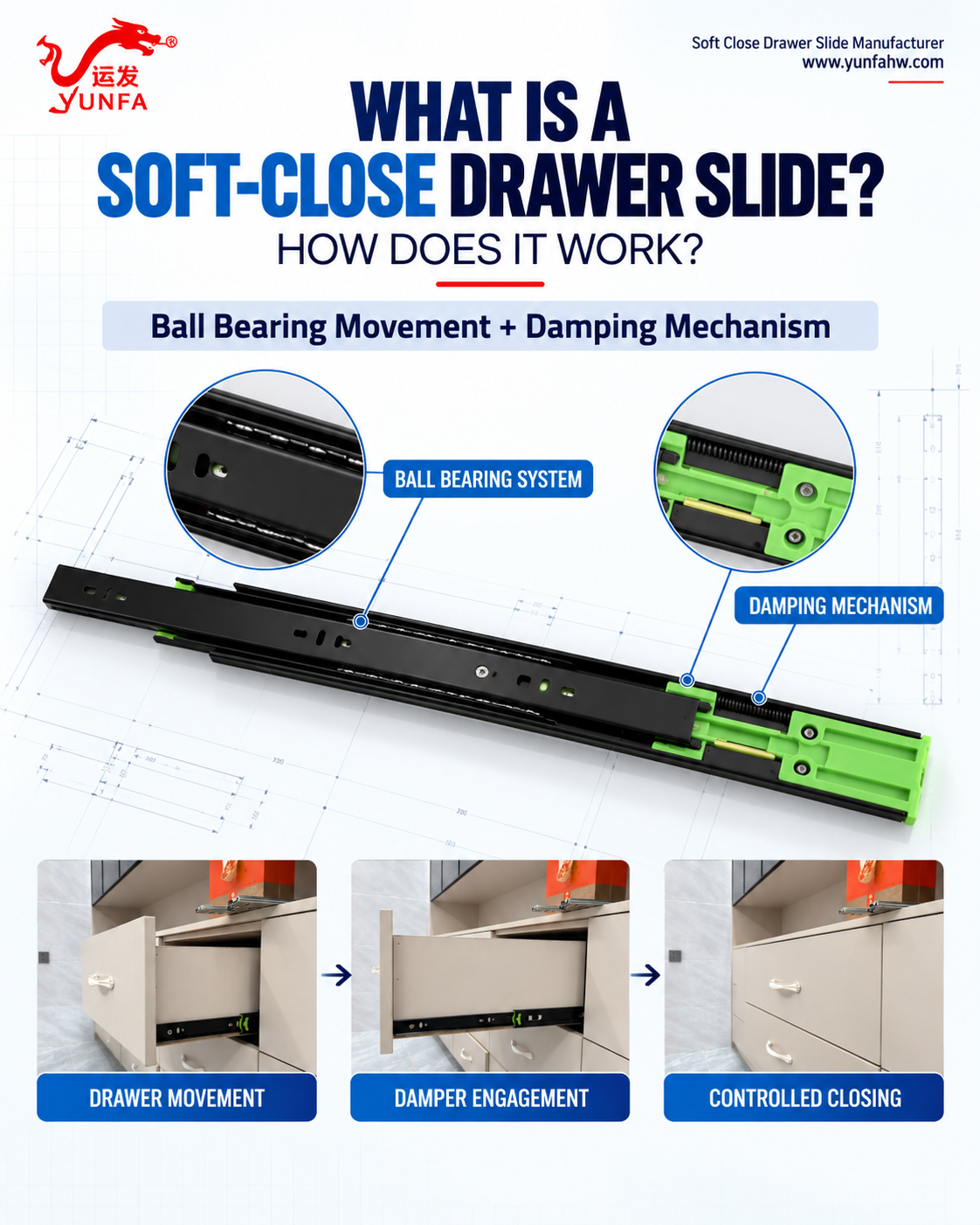
A soft close drawer slide is a ball bearing drawer slide equipped with a damping mechanism that controls the final movement of the drawer during closing.
Instead of allowing the drawer to close abruptly, the soft close mechanism slows the drawer during the final stage and helps guide it into the closed position. This creates a smoother, quieter, and more controlled closing experience.
Soft close drawer slides are widely used in kitchen cabinets, bedroom furniture, bathroom cabinets, office furniture, and other applications where controlled drawer movement and reduced closing noise are important.
YUNFA is a professional drawer slide manufacturer in China, supplying ball bearing drawer slides, soft close drawer slides, heavy duty drawer slides, and other drawer slide solutions for importers, wholesalers, and furniture manufacturers.
A soft close drawer slide uses a damping mechanism to control the final closing movement of a drawer.
When the drawer approaches the closed position, the damping mechanism engages and reduces the speed of the drawer. The slide then guides the drawer toward the fully closed position in a controlled manner.
The main benefits are:
l Smoother closing
l Reduced closing noise
l Controlled drawer movement
l Improved user experience
l Reduced impact during closing
The actual performance of a soft close slide depends on the slide design, damper system, load, installation accuracy, and application conditions.
A soft close drawer slide combines two functions:
Ball bearing movement
and
Controlled closing
The ball bearing system allows the drawer to move smoothly along the rails.
The soft close mechanism controls the final closing stage.
This means the slide is not simply responsible for moving the drawer. It also manages the drawer's movement as it approaches the closed position.
A soft close drawer slide is therefore different from a standard ball bearing slide, which provides smooth movement but does not necessarily include a damping mechanism.
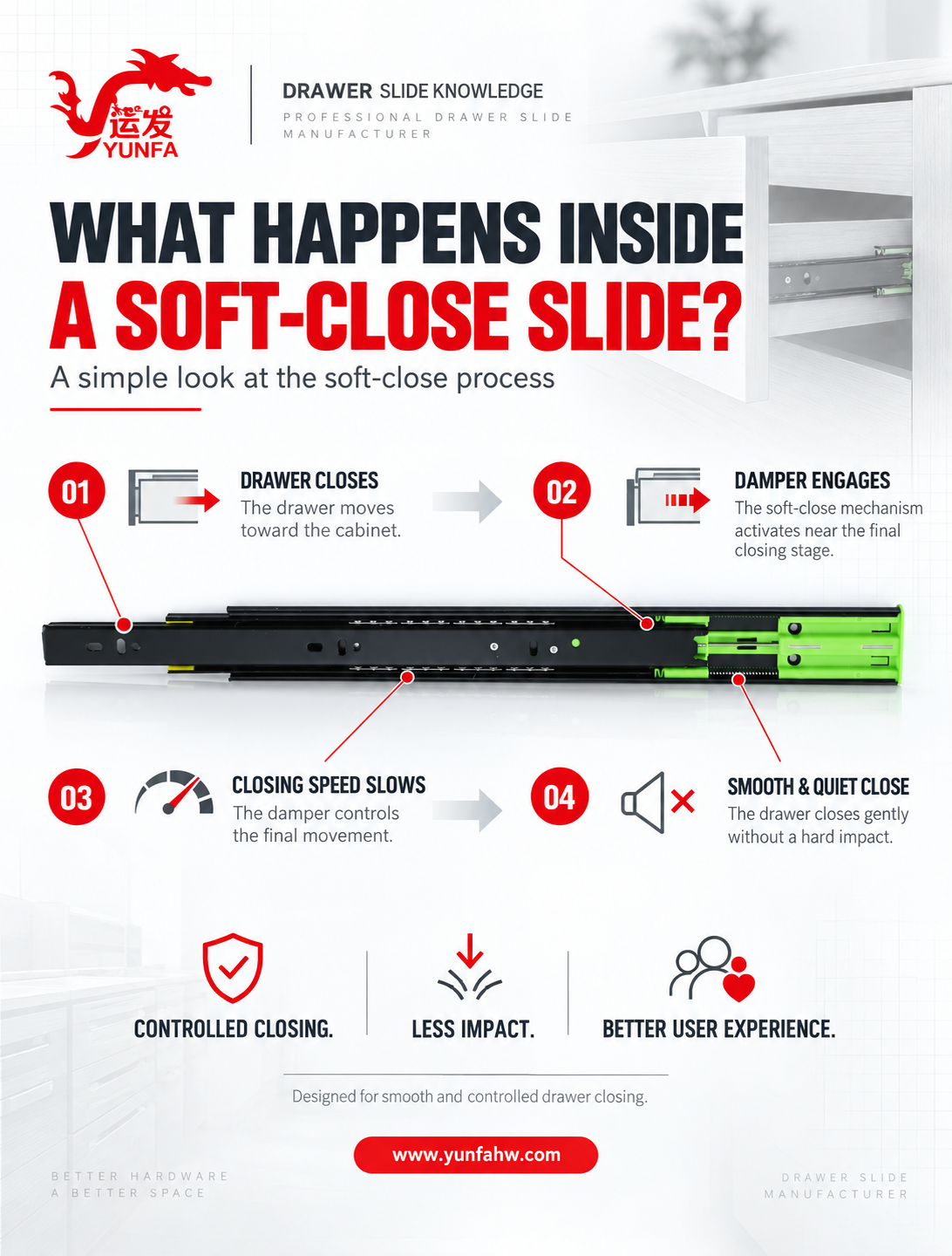
The exact internal design varies between manufacturers and product models, but the basic operating principle can be explained in several stages.
When the user pulls the drawer outward, the rails move through the ball bearing system.
The bearings help maintain smooth movement between the rail sections.
During most of the opening and closing travel, the drawer moves normally along the slide.
The ball bearing mechanism supports smooth movement between the rails.
As the drawer approaches the closed position, the soft close mechanism begins to control the final movement.
The mechanism absorbs or manages part of the drawer's kinetic energy.
The closing speed is reduced.
Instead of allowing the drawer to hit the cabinet at full speed, the mechanism provides controlled resistance.
The drawer is guided into the final closed position with a smoother and quieter movement.
This is the basic principle behind soft close operation.
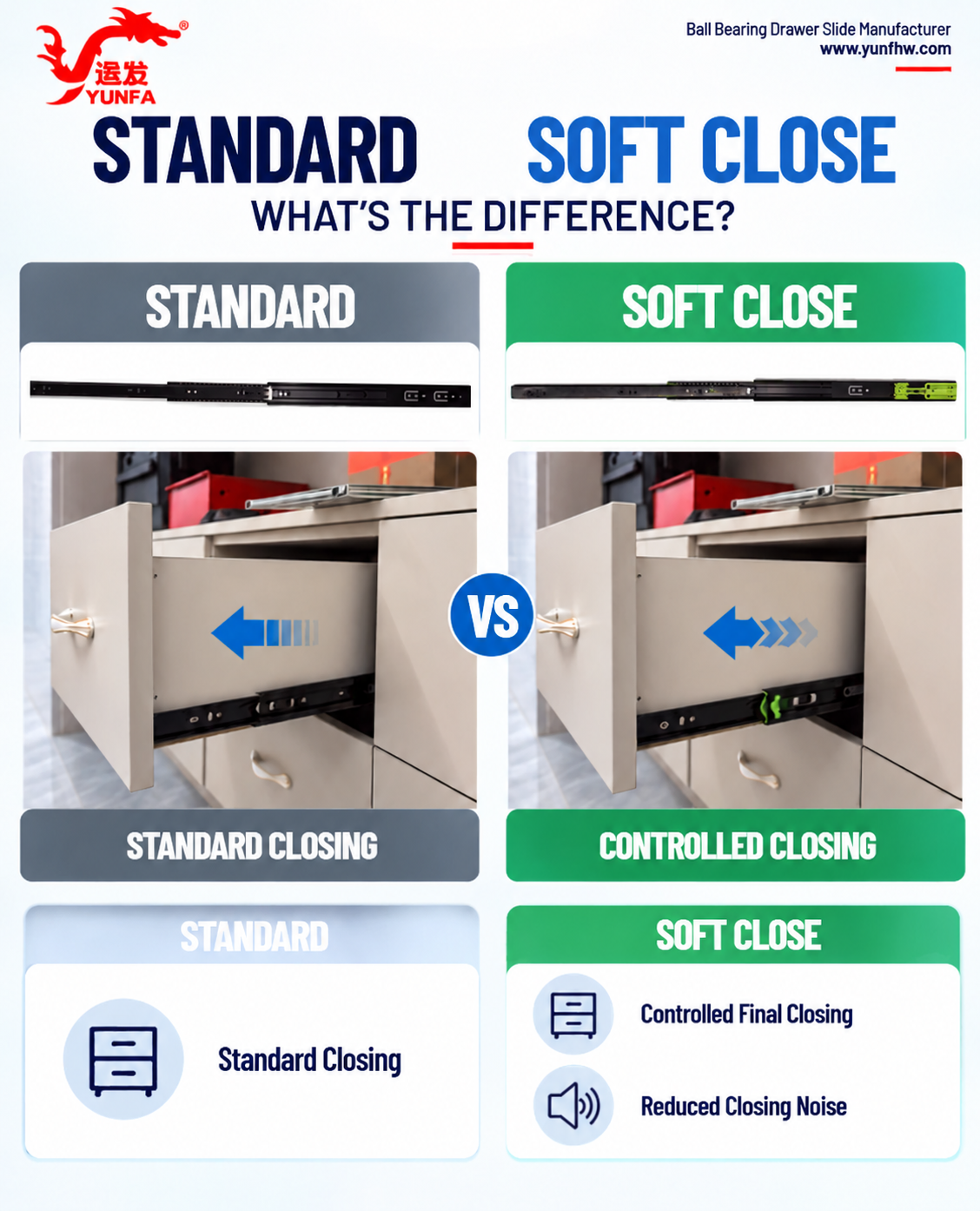
The main difference is the closing function.
Feature | Standard Ball Bearing Slide | Soft Close Drawer Slide |
Ball bearing movement | Yes | Yes |
Controlled final closing | No damping mechanism | Yes |
Closing noise | Standard | Reduced |
User experience | Standard | Smoother |
Mechanism | Simpler | Includes damping system |
Typical application | Standard furniture | Premium and quiet-use furniture |
A standard slide can be an effective choice when cost efficiency is the primary consideration.
A soft close slide becomes more attractive when quiet and controlled closing is an important part of the furniture's user experience.
Soft close functionality can add value to furniture in several ways.
The damping mechanism reduces the impact that occurs when the drawer reaches the closed position.
This can be especially useful in kitchens, bedrooms, offices, and other environments where excessive noise is undesirable.
A controlled closing action can make the furniture feel more refined and comfortable to use.
Controlled closing reduces the speed and impact of the drawer during the final stage.
This can help reduce unnecessary mechanical shock to the drawer and cabinet.
For furniture manufacturers, soft close functionality can be used as a value-added feature in products positioned above basic furniture ranges.
A practical selection process is:
Determine whether the slide will be used for kitchen furniture, bedroom furniture, office furniture, storage cabinets, or another application.
Confirm drawer width, depth, and available installation space.
Consider both the drawer itself and the contents it will carry.
Choose an appropriate width based on the required performance and available installation space.
Determine whether partial or greater extension is required.
Make sure the damping system is suitable for the drawer weight and intended usage.
Check mounting holes, side clearance, drawer alignment, and installation method.
For B2B buyers, sample testing is an important step before placing a large production order.
A soft close drawer slide combines the smooth movement of a ball bearing slide with a damping mechanism that controls the final stage of closing.
The main benefits are smoother operation, reduced closing noise, controlled movement, and an improved user experience.
However, soft close functionality should not be evaluated separately from the rest of the slide design. Furniture manufacturers and importers should also consider rail width, material thickness, load capacity, slide length, extension, mounting method, installation accuracy, and production consistency.
For standard furniture, soft close slides can add value where quiet and controlled operation is important. For heavier applications, buyers should select a dedicated heavy duty soft close solution that matches the required load.
YUNFA provides soft close ball bearing drawer slide solutions for importers, wholesalers, and furniture manufacturers, with different widths, configurations, and application options.
If you are selecting a soft close drawer slide for a new furniture project, provide YUNFA with your drawer dimensions, estimated loaded weight, required slide length, extension, and application. This information can help determine the appropriate slide specification before mass production.


