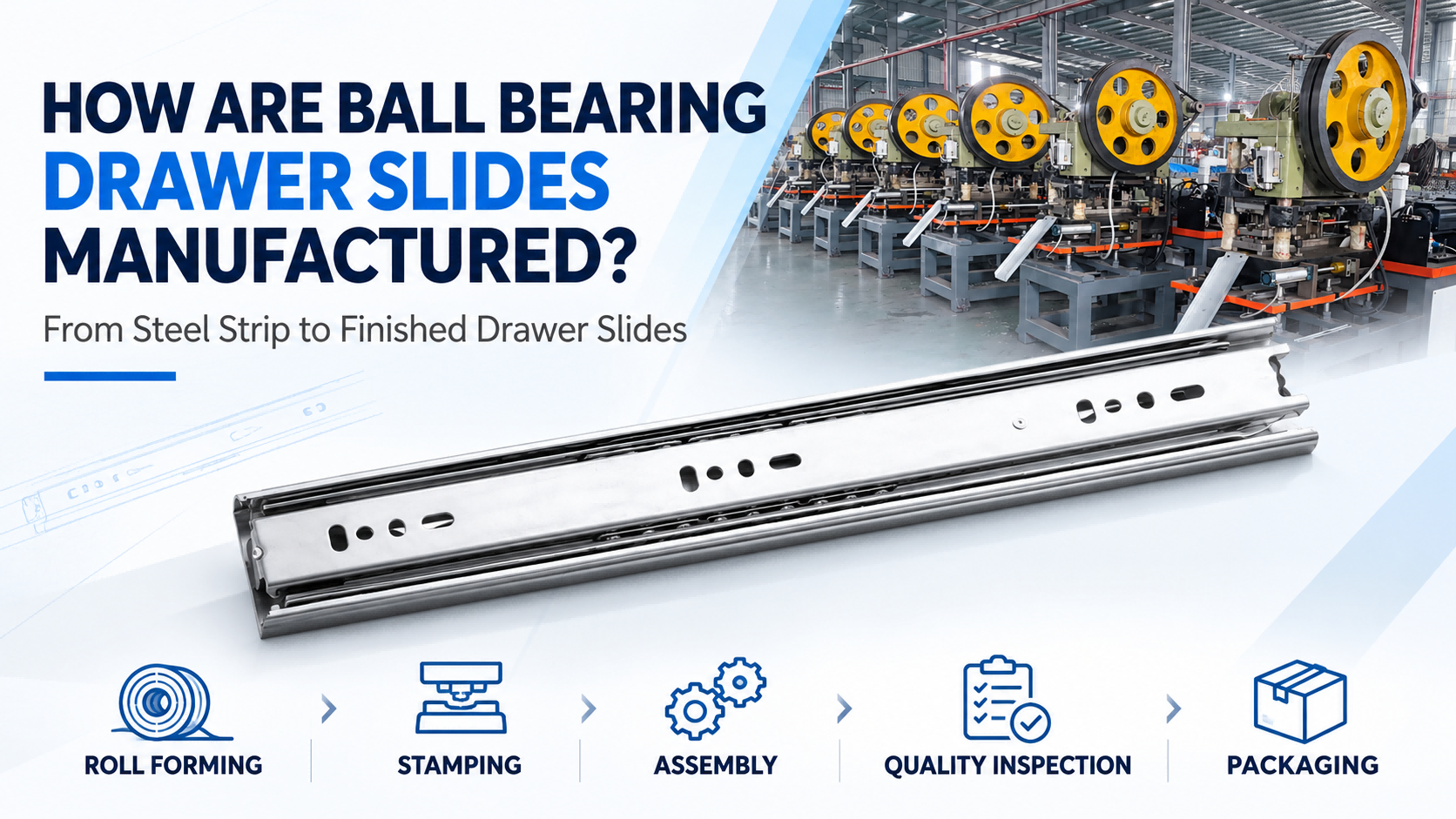
Ball bearing drawer slides are widely used in furniture, tool cabinets, storage systems, and industrial equipment. Their performance depends on more than the steel used to make them. Rail forming, precision punching, ball bearing assembly, component installation, and quality inspection all play important roles in producing a reliable drawer slide.
For furniture manufacturers, importers, and hardware wholesalers, understanding the manufacturing process helps when evaluating suppliers, comparing products, and selecting the right drawer slides for different applications.
In this guide, we explain how ball bearing drawer slides are manufactured, from steel strip processing to final packaging and shipment.
Ball bearing drawer slides are manufactured through a series of metal-forming, punching, assembly, and inspection processes. Steel strips are formed into rail profiles, mounting holes and functional components are produced, and ball bearings are assembled with the rails and retainers. The completed slides are then inspected, packaged, and prepared for shipment.
The exact process varies depending on the slide design, such as two-section slides, three-section slides, soft-close slides, or heavy-duty locking slides.
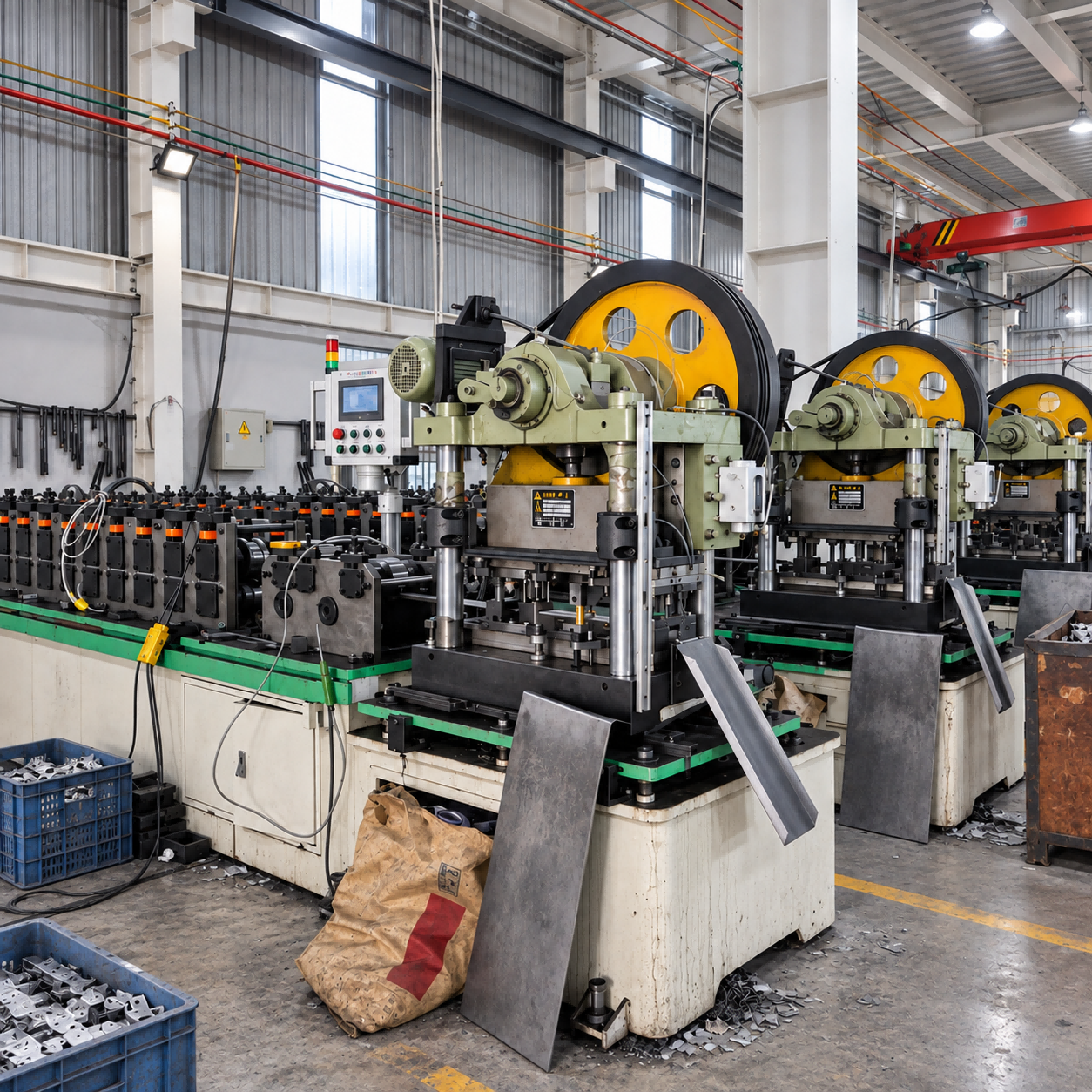
The manufacturing process begins with steel strip. During roll forming, the strip passes through a series of forming rollers that gradually shape it into the required rail profile.
The shape of each rail is important because the rails must fit together correctly and support smooth sliding movement.
Consistent forming helps manufacturers maintain the dimensions and profile required for assembly. Material specifications and rail design also influence the finished product's performance.

Ball retainers and related metal components help position and support the ball bearings within the slide assembly.
Depending on the product design, these components may be produced through stamping operations. The required shape, dimensions, and forming accuracy must match the intended slide structure.
Consistent component production helps reduce assembly difficulties and supports reliable movement during use.
Ball bearings are fitted into the designated positions in the plastic strip. This component helps position and guide the ball bearings, supporting smooth movement of the drawer slide.

Mounting holes and slots are produced in the inner rail according to the product specification.
These openings allow the slide to be attached to the drawer or cabinet. Their position, size, and spacing affect installation compatibility.
For furniture manufacturers and cabinet producers, consistent hole positioning is particularly important when slides are installed repeatedly across large production batches.
For slide models equipped with a release mechanism, the release lever is installed during this stage.
The mechanism allows the inner rail to be released from the slide assembly when the product is designed for that function. Correct positioning and installation are important for proper operation.
Not every drawer slide uses the same release mechanism. The assembly process therefore depends on the specific model and its intended application.
The ball bearings, retainer components, and intermediate rail are assembled according to the slide's structural design.
In a three-section drawer slide, the intermediate rail connects the inner and outer rail system and enables the drawer to extend farther than a basic two-section design.
During assembly, the components must be positioned correctly so that the rails can move relative to one another. Proper alignment is essential to the intended sliding action.
Stoppers are installed to help control rail travel and prevent the moving sections from exceeding their designed range.
Their position and fit depend on the slide model. Correct installation helps the slide operate within its intended travel limits.
Because stopper designs can vary, manufacturers must follow the corresponding product specifications rather than use one arrangement for every model.

The inner rail is assembled with the relevant components according to the product structure.
This stage brings together the inner rail and the parts required for its movement and connection to the other rail sections.
Consistent assembly helps ensure that the completed slide can be installed and operated as intended.
The outer rail is assembled with the corresponding components to complete the main rail structure.
The inner, intermediate, and outer rails must fit together correctly for multi-section slides. Misalignment or inconsistent assembly can affect movement and the overall user experience.
Manufacturers therefore need to maintain consistent assembly procedures for each product model.
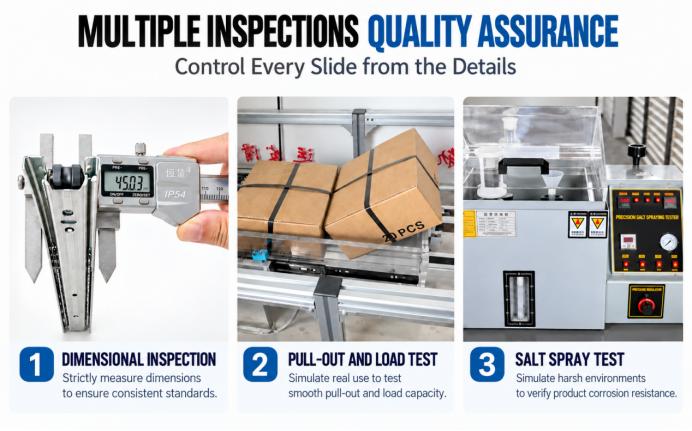
After assembly, the slides undergo manual quality inspection.
Depending on the product and inspection plan, checks may include:
l Overall appearance and surface condition
l Rail alignment and assembly
l Mounting holes and component positioning
l Sliding smoothness
l Visible defects or missing components
Inspection requirements should be matched to the product specification and the manufacturer's quality procedures.
For applicable designs, the outer rail is crimped and the required safety retainer is installed.
These operations help secure the relevant components within the intended assembly. The process must be controlled carefully to avoid affecting rail movement or damaging the product.
The exact method depends on the slide's construction and design requirements.
After the required inspection and assembly stages, the finished slides are prepared for packaging.
Packaging may include transparent bags, customized printed bags, or other packaging formats selected for the customer and product.
For export orders, packaging should also consider product protection, quantity identification, handling, and the buyer's requirements.
Automatic packaging can help improve consistency and efficiency for suitable products and packaging formats.
14
The final stage involves packing the products into cartons, securing the cartons, and preparing the order for shipment.
Carton strapping helps secure packages during handling and transportation. Appropriate outer packaging is also important for protecting the products during storage and international shipping.
For overseas buyers, consistent packaging and clear order identification help support receiving, inventory management, and distribution.
YUNFA is a drawer slide manufacturer based in Jieyang, Guangdong, China. Founded in 2008, the company supplies ball bearing drawer slides for importers, wholesalers, and furniture manufacturers.
Our product range includes standard ball bearing slides, soft-close slides, bayonet mount slides, and heavy-duty drawer slide options for different applications.
Our manufacturing operations cover rail forming, component processing, assembly, quality inspection, packaging, and shipment preparation. We also work with customers on product requirements such as slide dimensions, thickness, hole positions, functions, and packaging, depending on the model and production requirements.
For buyers sourcing drawer slides for furniture, tool cabinets, or storage systems, understanding the product specification and intended application is an important first step toward selecting a suitable solution.
Explore YUNFA's product range and manufacturing capabilities at www.yunfahw.com.


