
For furniture manufacturers, hardware wholesalers, importers, and private-label brands, standard drawer slides may not always meet every product requirement. Different furniture designs, installation methods, market preferences, and packaging needs can require specific drawer slide configurations.
OEM drawer slides offer a way to source products tailored to these requirements. Depending on the manufacturer's capabilities and the product design, customization may involve dimensions, material thickness, mounting hole positions, functional features, surface finish, and packaging.
However, successful OEM manufacturing involves more than requesting a few product changes. Buyers need to define their specifications clearly, confirm technical feasibility, evaluate samples, and establish consistent requirements before mass production.
In this guide, we explain how OEM drawer slide manufacturing works, what can be customized, and how to choose the right manufacturing partner for your business.
Not every project requires a completely new design. In many cases, buyers can begin with an existing slide model and adjust selected specifications to meet their needs.

Drawer slide dimensions must match the available installation space and the drawer's design.
Common ball bearing drawer slide widths include 27mm, 35mm, 40mm, 45mm, and 53mm heavy-duty configurations. Available dimensions depend on the manufacturer's product range.
Length selection is equally important. The slide must fit the cabinet or equipment and provide the required extension.
Before requesting customization, buyers should confirm the required slide length, available installation depth, drawer dimensions, and desired extension type.
Material thickness can affect the structural characteristics of a drawer slide, but thicker material alone does not guarantee better overall performance.
The appropriate specification depends on the rail design, intended application, required load rating, and other product characteristics.
For OEM projects, buyers should discuss the required material specification with the manufacturer and confirm performance through appropriate product evaluation.
Mounting holes and slots determine how the slide attaches to the drawer and cabinet.
Furniture manufacturers may require specific hole positions to match existing production designs, cabinet structures, or assembly procedures.
Providing a dimensioned drawing or clearly marked reference sample can help reduce misunderstandings during development.
If the mounting configuration differs from an existing model, the manufacturer should confirm whether the change is feasible and whether new tooling or process adjustments are required.
Different applications may require different slide functions. Depending on the manufacturer's available designs, OEM options may include:
l Standard ball bearing slides: For conventional drawer movement.
l Soft-close slides: Designed to slow the drawer during closing.
l Locking slides: For applications requiring a locking mechanism.
l Bayonet mount slides: For compatible mounting arrangements.
l Heavy-duty slides: For applications that require suitable heavy-duty configurations.
These are not interchangeable options. Buyers should identify the required function and intended application before selecting a model.
The required appearance may vary according to the target market, furniture style, or customer's product range.
Depending on the existing product and available manufacturing processes, buyers can discuss suitable surface finishes and color requirements with the supplier.
Any requested finish should be confirmed against the product specification and evaluated for suitability for its intended use.
Packaging is an important part of an OEM project, particularly for importers, wholesalers, and brands selling through retail or distribution channels.
Possible packaging requirements include:
l Transparent polybags
l Custom-printed color bags
l Retail-oriented packaging
l Product labels and identification
l Carton specifications and packing quantities
Buyers should provide packaging artwork, labeling requirements, target quantities, and any relevant shipping or distribution requirements before production begins.
Private-label packaging and product branding should be confirmed separately from the technical slide specification.
The right choice depends on how closely an existing product matches your requirements.
Consideration | Standard Drawer Slides | OEM Drawer Slides |
Product specifications | Existing specifications | Agreed customer specifications |
Development | Usually simpler | May require technical review and sampling |
Tooling | Typically uses existing tooling | New tooling may be needed for some changes |
Packaging | Existing options may be available | Can be tailored to agreed requirements |
Lead time | Depends on stock and production schedule | Depends on development, materials, tooling, and production |
Best suited for | Buyers whose needs match existing models | Buyers with specific product or branding requirements |
Standard products can be a practical option when the existing specifications meet your needs. OEM manufacturing becomes more attractive when you need a defined combination of dimensions, features, mounting details, or packaging.
Customization does not automatically mean a better product. The objective is to achieve the right specifications for the intended application.
A clear development process helps both the buyer and manufacturer manage technical requirements, timing, and quality expectations.
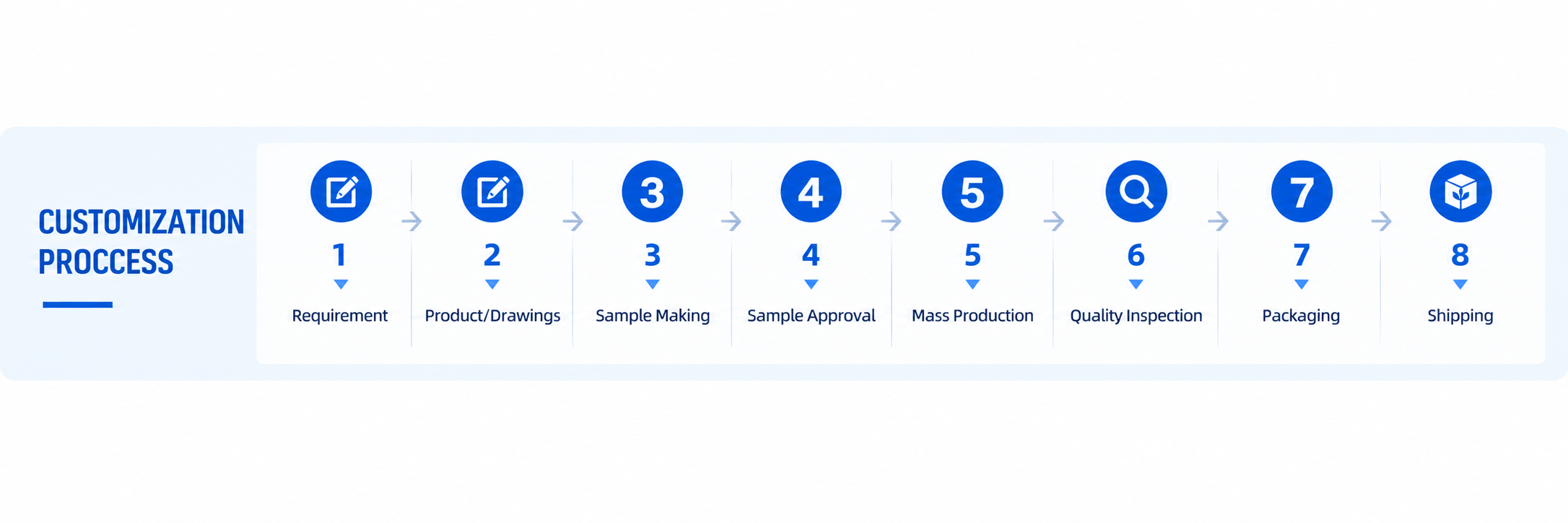
Begin by identifying the application and the requirements the slide must meet.
Useful information includes:
l Application: furniture drawers, tool cabinets, storage systems, or other equipment
l Required slide width and length
l Two-section or three-section design
l Required extension
l Standard, soft-close, locking, or other functional requirements
l Mounting hole positions
l Material and finish requirements
l Packaging and labeling preferences
Not every project needs every detail at the first inquiry stage. However, the more clearly the essential requirements are defined, the easier it is for the manufacturer to assess feasibility.
Before sampling or production, both parties should agree on the important product details.
These may include dimensions, material specifications, mounting holes, functional components, finish, packaging, and applicable performance requirements.
Technical drawings, a reference sample, or a written specification sheet can help establish a common reference.
Avoid relying on vague descriptions such as "stronger," "thicker," or "better quality" without defining what those terms mean for the product.
If a sample needs revision, record the specific issue and confirm the updated specification before approval.
A sample should be representative of the product you intend to order, not simply a similar-looking alternative.
Once the product specification is agreed, confirm the commercial requirements.
These typically include unit price, minimum order quantity, tooling charges if applicable, sample arrangements, production lead time, payment terms, packaging, and shipping arrangements.
Lead times and minimum order quantities can vary depending on the product, customization scope, production schedule, and material availability.
Buyers should request clear confirmation rather than assume that all customized models follow the same terms.
Quality checks should reflect the characteristics that matter for the specific model. For example, a soft-close slide requires appropriate evaluation of its closing function, while a locking slide requires verification of the relevant locking operation.
Pack products according to the agreed packaging and labeling requirements.


